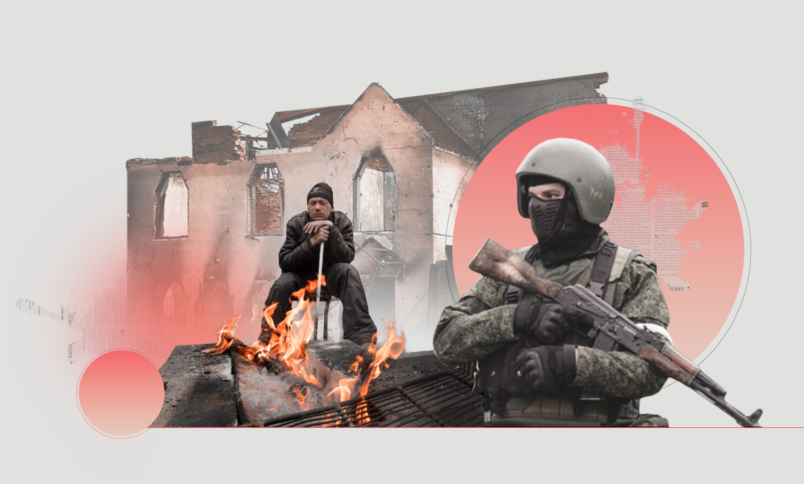
Most journalists find it challenging to write about the situation in the temporarily occupied territories. Ukrainian media workers cannot openly come to Russian-controlled territories and work there, and private trips are associated with a risk to freedom and life. For the most part, journalists have to collect all information without personal presence, using a variety of sources.
It is difficult and sometimes impossible to verify such information, especially quickly. Contacts with people who live in the occupied territories are limited due to the blocking of websites and popular social networks by the Russian authorities, due to problems with the Internet and communication. Russian occupiers can also monitor people who pass information to Ukrainian media.
Due to all of the above, materials devoted to the life of Ukrainians in the temporarily occupied territories often lack completeness, accuracy, and impartiality. Superficial coverage of the topic, use of unverified information and social networks, manipulative headlines, hate speech are only some violations of the Ethics Code of the Ukrainian Journalist committed by the media.
Despite the difficulties and obstacles that arise during the collection of facts and comments about life in the occupied territories, the coverage of this topic is of great importance, considering the fact that Russia seeks to create a distorted propaganda picture for the whole world. In addition, it is important for Ukrainians living under occupation to be involved in Ukraine’s general information space and receive news about their lives from Ukrainian media.
The Commission on Journalistic Ethics developed recommendations to help journalists work on materials about the lives of Ukrainians in occupied territories.
- One of the common mistakes in coverage of the topic is the depersonalization of all residents of the occupied territories. These people are rarely given a voice (even anonymously); instead, their lives are described by officials, politicians, or the military. Investigate how to ask about the needs and lives of Ukrainians in occupation personally. Include these people’s opinions in your materials. It is unacceptable when the material discussing the action plan after de-occupation does not include the point of view of those who live in the occupied territories.
- Journalists should be persistent in finding their own sources. Yet, it is necessary to provide for security measures, especially digital security, because a person in occupation faces a major risk while communicating with Ukrainian journalists or transmitting information to the Ukrainian media. While your interlocutor may not necessarily have digital security skills, it is your duty to take care of the person’s safety and instruct them how to go about communicating with you.
- Do not disclose names of people in occupation, even if they consent to publication, do not share these people’s contacts with colleagues who are not involved in the writing of a specific material, and do not include your sources in general databases, newsletters, or group chats. Appreciate the trust and be grateful to the person who shares the information with you.
- Even if you believe that your sources in the occupied territories are reliable, keep in mind the context of their daily lives, in particular, the difficult stressful conditions and constant pressure, the significant influence of Russian propaganda and disinformation. If possible, try to confirm the received information from other sources.
- Question the content of anonymous channels and websites that often share photos and videos from the occupied territories. Try to verify information through your own sources, check photos and videos for authenticity. Share the steps you have taken to verify information with your audience.
- Be critical of any information spread by Russian propaganda because its task is to paint the necessary “picture” of mass “support” for the actions of the aggressor in the occupied territories. On the other hand, the content of Russian resources may be used to confirm Russian war crimes, identify individuals collaborating with the occupation regime, etc.
- Avoid generalizations that discriminate against a large group of Ukrainians (such as “all normal people left, only fans of the ‘Russian world’ remained,” “it’s their fault they are occupied” etc.). Make sure to distinguish between those who work for the benefit of the occupation regime and those who are essentially held hostage by the occupiers. Both categories should be approached impartially: for example, avoid calling all those who received a Russian passport collaborators and traitors because Russia issues passports in the occupied territories by force.
- The concepts of “collaborationism” and “collaborator” are used in the Ukrainian media both in the legal sense (regarding those who are subject to the law on collaborationism) and in the mundane sense (to identify somebody’s views rather than actions). The Commission recommends that journalists avoid using the word “collaborator” in this generic sense and speak about a specific person’s actions or statements instead. As for collaborationism as a crime, in addition to rebroadcasting official messages from law enforcement agencies, the media should clarify who a collaborator is and in which cases responsibility may arise.
- There is a great demand in society for information not only about today’s life, but also about the future after the restoration of Ukraine’s territorial integrity. Expand the range of topics related to the lives of people in the occupation, give them practical information and answer the questions that concern them.
This publication was made possible with the financial support of the Media Development Fund Program of the US Embassy in Ukraine. The opinions and judgments expressed herein do not necessarily reflect the position of the US Government.