
For 20 years, the Commission on Journalistic Ethics has been engaged in forming the culture of professional, honest journalism, and thus building trust in the media and strengthening freedom of speech in Ukraine.
Over the years, it saw the Orange Revolution, the Euromaidan, the Revolution of Dignity, Russia’s occupation of Crimea, the war in eastern Ukraine, the COVID-19 pandemic, and the introduction of martial law due to the full-scale Russian invasion of Ukraine on February 24, 2022.
In 1999, in an interview with Den newspaper, Volodymyr Mostovyi, the founder of Dzerkalo Tyzhnia newspaper and the first head of the Commission, said:
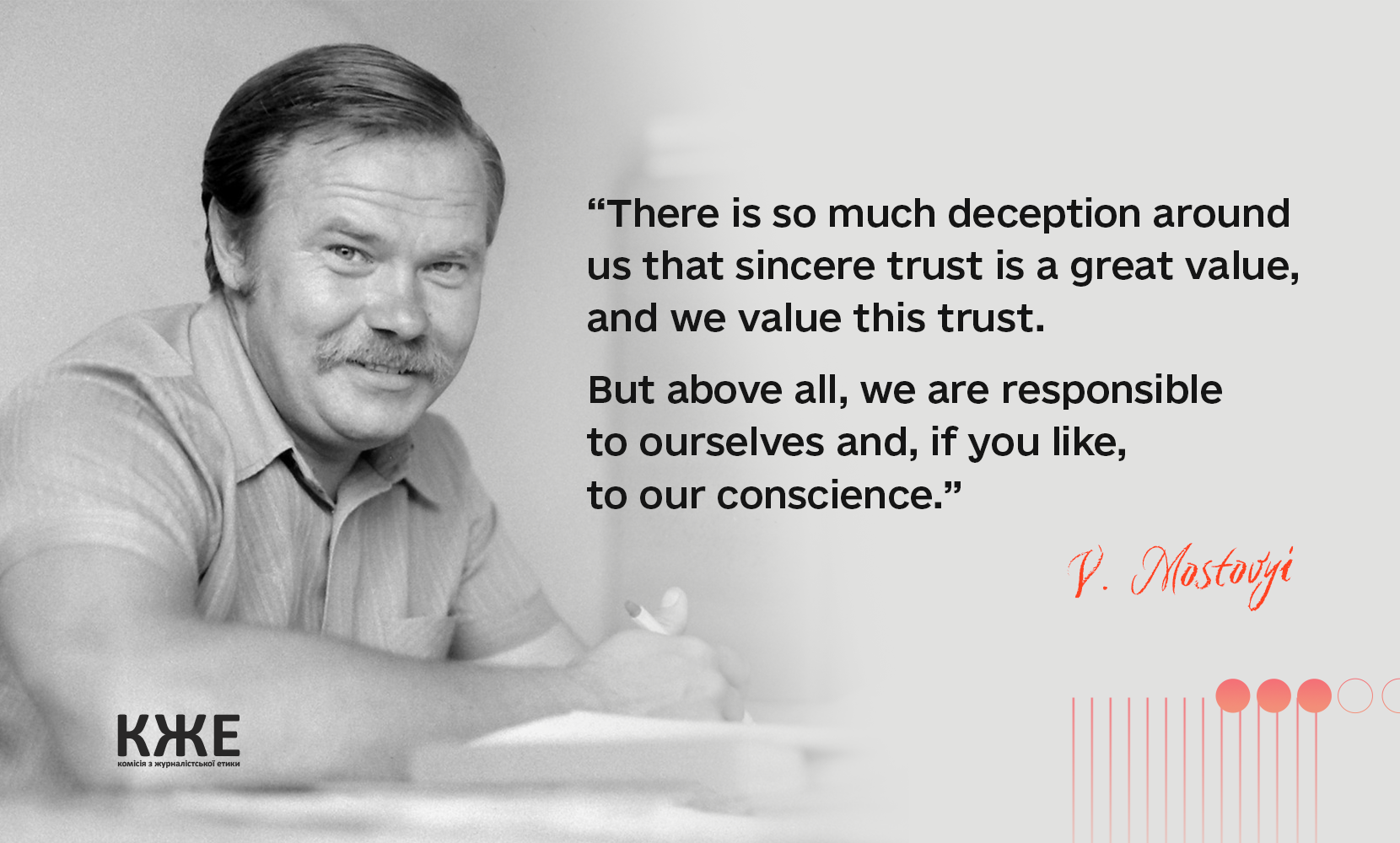
Rest in peace — Volodymyr Mostovyi passed away earlier this year.
In 2004, the Ethics Code of the Ukrainian Journalist was created — a document identifying the key moral and ethical standards that must be observed by media workers. Since the Code consists of only 19 items, the Commission makes every effort to explain current issues regarding ethical challenges to journalists.
In 2023, the President of Ukraine signed the new law “On Media.” The law mentions the Ethics Code. In order to help journalists with the new document, the team of the Commission prepared explanations of individual points, as well as answered individual requests from newsrooms.
Decision and Recommendations of the Commission
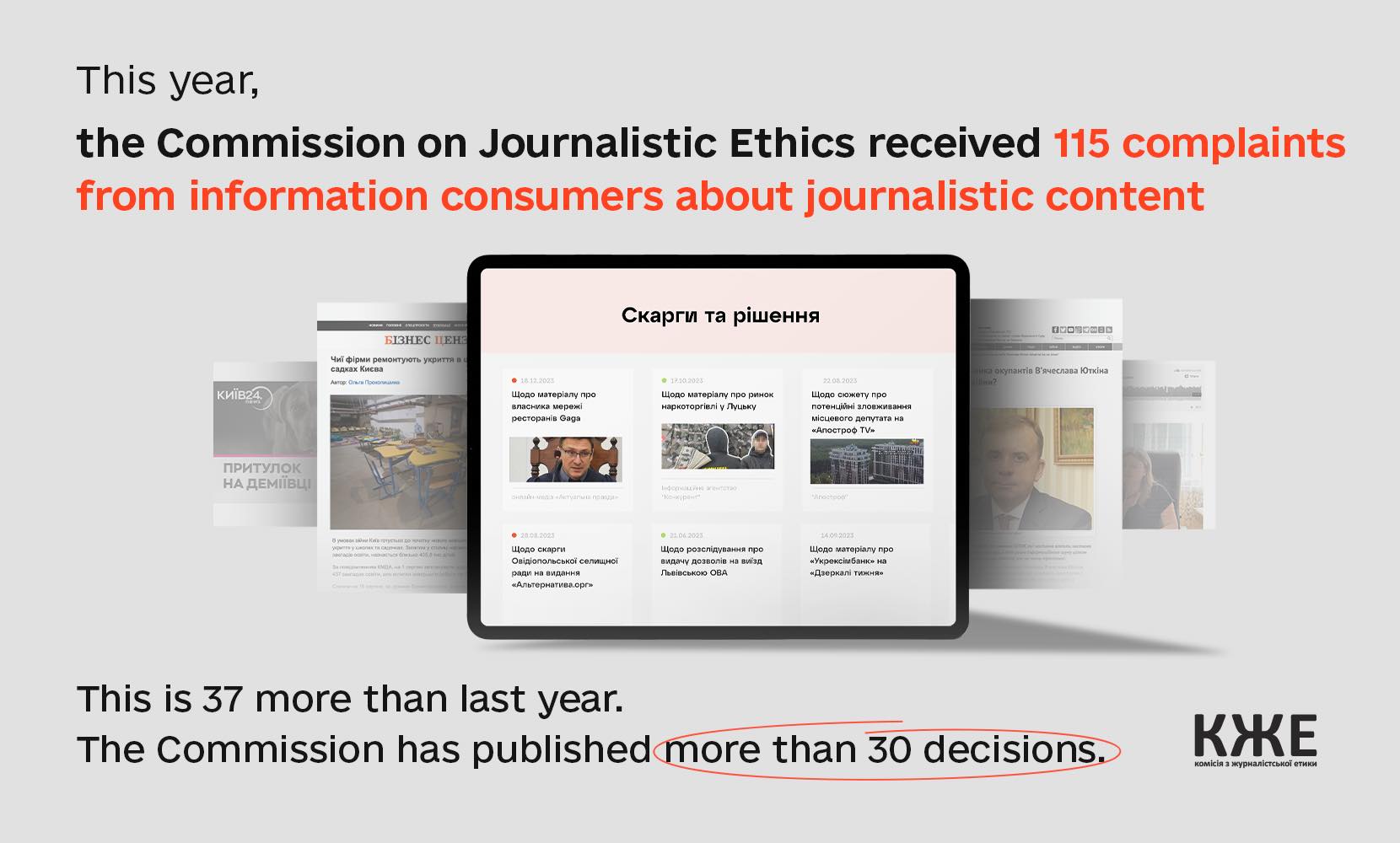
In addition, during the year, we prepared 13 statements and recommendations regarding compliance with ethical norms and standards of the journalistic profession.
This includes:
- Recommendations of the Commission on Journalistic Ethics Regarding the Use of Artificial Intelligence to Create Journalistic Materials
- Recommendations by the Commission on Journalistic Ethics Regarding Covering the Lives of Ukrainians in Temporarily Occupied Territories
- On the Inadmissibility of Spreading Hate Speech against People with Autism in the United News Telethon
- Commission’s Recommendations on Proper Coverage of the Subject of Military Draft in Ukraine
- CJE Recommendations on Interviewing Russian Prisoners of War in Ukrainian Media
During the year, we received requests from journalists regarding pre-publication examination of materials. The Commission noted an increased interest from newsrooms to adhere to recommendations and fix errors.
“I often write about sensitive topics, but I do not want to violate anyone’s rights, harm the characters of my material, or violate journalistic standards. My goal is to help them get along and not ruin each other’s lives. I decided to turn to the Commission on Journalistic Ethics in order to protect myself from mistakes (as a journalist) and the publication I work for from reputational losses. Journalists, like doctors, should remember the commandment ‘Do no harm.’ The Commission’s tips are very useful; they suggest a certain course of action and warn against mistakes. I will definitely follow them., – Oksana Havrysh, Chetverta Vlada journalistic investigative agency
A few more successful cases of cooperation with newsrooms:
- CJE Helped to Correct StopCor’s Material about a Survivor of Sexual Violence
- Commission on Journalistic Ethics Helps Audience and Team of a Rivne Media Outlet to Eliminate Violations
- The municipal enterprise of Kyiv City Council “Kyiv TV Company” Expresses Gratitude to the CJE for the Assistance
Education and Training
Another important vector for the Commission is education. We held over 20 lectures and discussions for journalists.

We invited professional media workers to share their experience: Andrii Dubchak, founder of Donbas Frontliner, Mykola Chernotytskyi, head of Public Broadcasting, Yuliia Mostova, co-founder of Dzerkalo Tyzhnia, Volodymyr Yermolenko, president of Ukrainian PEN, Yevheniia Motorevska, head of the military investigations department of The Kyiv Independent, Tetiana Troshchynska, chief editor of Hromadske Radio, and many others.
The Commission also released a series of explanatory videos on journalistic standards. The explainers talk about how journalists can help bring Russia to justice for war crimes in Ukraine, how the media can responsibly correct their mistakes, how bloggers differ from professional journalists, and how to talk about a hero’s traumatic experience in the media.
The total number of views of these events on Facebook exceeds 23,000, on YouTube — it is over 12,000.
The total reach (number of people who saw any content of the page) of the Commission’s Facebook page over the year surpasses 160,000.
We also drafted a Handbook on Journalistic Ethics. This was a request from the audience. The book provides practical recommendations regarding the adherence to ethical standards in the media field. It provides recommendations on covering messages published on social media, explains the characteristic features of the use of the main journalistic genres, covers the issues of journalistic standards, gender equality, the specifics of the activities of journalists and the media during martial law. It is useful for journalists, media managers, students and teachers of journalism departments.

“This handbook is critical today. We will use information included therein and recommend it to students as part of our subjects ‘Introduction to Journalism’ and ‘Media Law.’ We will also use the materials with students who write their term papers,” says Antonina Ivashchuk, head of the department of advertising and public relations at the Faculty of International Relations of the National Aviation University.
“We are sincerely grateful for your work — so timely, rich, practically oriented. This is a real gift before the beginning of the academic year to both our students and the teachers of the course ‘Journalistic Ethics and Media Law,’” says Lesia Malevych, head of the department of journalism and Ukrainian studies of the National University of Water and Nature Management.
“The advantage of the handbook is that the authors give clear practical advice that can be immediately used at work. As a person interested in language culture and covering language culture in the media, and also one who writes a thesis about this subject, I was particularly drawn to the section with recommendations on the use of stylistically colored vocabulary in journalistic materials about the war,” shares Karyna Matviichuk, master student of the Mykhailo Drahomanov Ukrainian State University.
Media Research

In cooperation with the Ilko Kucheriv Democratic Initiatives Foundation, the Commission conducted two studies:
- No Such Thing as Too Much Ethics: How is journalistic ethics taught in Ukrainian universities?
- Introducing the Single Press Card in Ukraine: Survey of Journalists
International Level
The Alliance of Independent Press Council in Europe (AIPCE) has expelled the Russian “Public Board of Complaints against the Press” on September 15, 2023. The Commission had been fighting for this decision since April 2022 and, as a sign of protest, suspended its participation in the Alliance. As a sign of solidarity with Ukrainian media representatives, participants from 10 other countries suspended their membership in AIPCE.
On December 14, 2023, the general meeting of the Alliance in Antwerp (Belgium) supported the return of Ukraine and the 10 other countries to the organization. These are the press councils of Armenia, Belgium, Denmark, Estonia, Finland, Georgia, Moldova, Ireland, Norway, and Sweden. Thanks to the Commission’s strong position, it led to a change in the composition of the Coordination Committee of the Alliance, in its work procedure, fully terminating Russian representatives’ membership.
Andrii Kulykov, the head of the Commission on Journalistic Ethics, took part in the meeting of The Organization of News Ombudsmen and Standard Editors, which took place in London (UK) from May 31 to June 2, 2023. The panel discussion on Ukraine was focused on the challenges Ukrainian journalists and media face due to the war.

The members of the Commission also took part in the Re:Cover conference, which was held on November 25-26 in Kraków. The event is part of the “Voices of Ukraine” program. It was organized European Center for Press and Media Freedom (ECPMF). The conference brought together journalists and media experts who are conducting a dialogue about how Russia’s war against Ukraine is changing journalism.
Acknowledgments
We are thankful to our partners, journalists and newsrooms, students and teachers of journalism departments, applicants and complainants. We are thankful to everyone who, with their daily work, brings us closer to the establishment of ethical journalism in Ukraine.
Furthermore, we thank our partners who support media initiatives in Ukraine in difficult times: UNESCO, International Media Support (IMS), Media Program in Ukraine by Internews, Fund for the Development of Ukrainian Media of the US Embassy in Ukraine, and others.
A big thanks to all the members of the Commission, who continue to work daily pro bono.