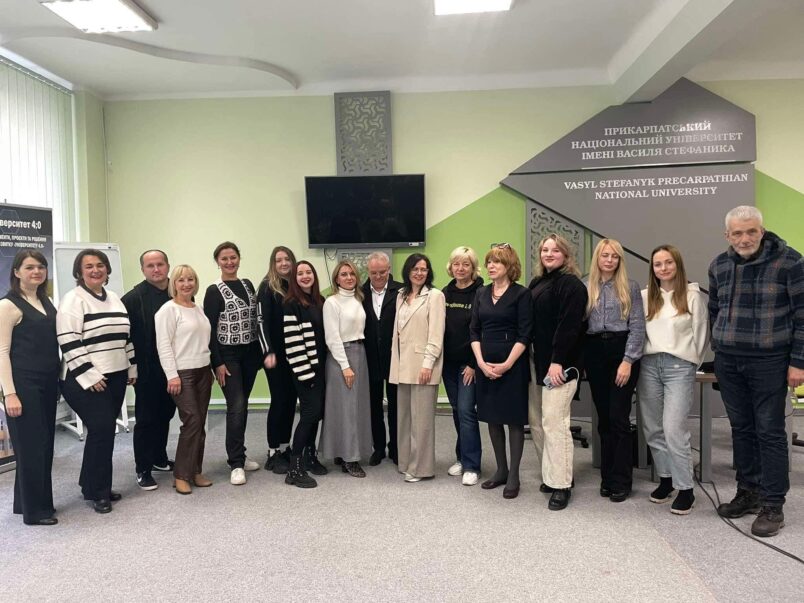
On October 15, members of the Commission on Journalistic Ethics, led by Andrii Kulykov, co-founder of Hromadske Radio, visited the Vasyl Stefanyk Precarpathian National University. Mr. Kulykov was accompanied by other Commission members — head of the Suspilne supervisory board Svitlana Ostapa and public activist and media manager Tetiana Lebedieva.
The meeting brought together students from the journalism department, teachers, and representatives of regional media. The discussion, which took place after an air raid alert, was dedicated to the challenges of the Ukrainian journalism during the war. Students and teachers of the Vinnytsia State Pedagogical University also took part in the event online.
Svitlana Ostapa noted that the meeting once again reminded the attendees of the realities of war:
“Before we even started the meeting, an air alert started, and we all together, about 80 people, moved to a room in the basement. Fortunately, the alert was not too long, and we were able to continue our conversation soon as planned. Students were actively interested in whether it is possible to violate the standards of journalism during war, how to cover the deaths of civilians during shelling, whether our attitude towards foreign media has changed. I saw a sincere interest in the topic of the meeting. I am very happy that such a generation is growing up among us.”
Andrii Kulykov emphasized how important it was to observe journalistic standards during the war:
“A timely recorded and published video on how to act during a chemical, air or nuclear alert saves lives. But there are things that cannot be made public immediately so that the enemy does not take advantage of it. Now the promptness of providing information becomes a matter of timeliness.”
Tetiana Lebedieva emphasized the importance of regional meetings for a more profound understanding of journalistic issues on the ground:
“The Commission on Journalistic Ethics highly values the possibility to organize regional meetings. This gives us an opportunity to meet not only regional journalists, but also students and teachers. In times of war, this becomes doubly important: we better understand how local media work and what challenges students and journalists face.”
At the end of the meeting, the participants discussed the role of the Commission on Journalistic Ethics in the support of transparency of Ukrainian media, as well as the importance of media literacy. The Commission continues its cooperation with universities, training future journalists before crucial wartime work.
According to the message on the university website, “this event became an important milestone in the training of future media professionals, giving them an opportunity to not only hear about the theoretical fundamentals of journalistic ethics, but also learn about the practical experience of prominent Ukrainian journalists and media managers.”