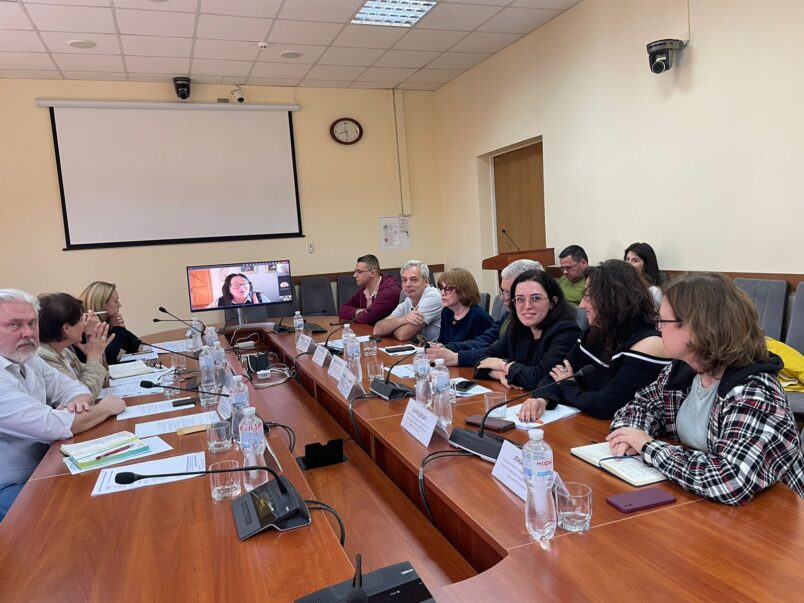
In May 2024, members of the Commission on Journalistic Ethics held a work meeting with Ukraine’s media regulator, the National Council of Ukraine on Television and Radio Broadcasting.
Olha Herasymiuk, chair of the National Council, emphasized that joint regulation in the media sphere does not restrict the freedom, professional and other independent regulation in the sector of media and journalism, and that developing a system of joint regulation is the right path. Everyone who works in the media, everyone who teams up as journalist groups or workshops, should take care of professional ethics.
Andrii Kulykov, head of the Commission on Journalistic Ethics, stressed that the Commission is a self-regulating agency that works, delivers results, develops and makes effort to promote self-regulation in the Ukrainian media.
“It would be great if members of the media market didn’t say and think that there is no self-regulation in Ukraine. This does not make us all stronger, quite the opposite — as a self-regulating agency, the Commission on Journalistic Ethics has its own mandate and, consequently, a focus of effort. This includes any complaints against publications in the media when the complainant seeks to improve the quality of content, terminate a certain practice or improve the journalist’s professionalism. When a complainant wants punishment, this is probably rather a matter of litigation.”
He also emphasized that there should be a productive dialogue with new co-regulation agencies to identify the areas of responsibility among self-regulation and co-regulation. In addition, the sphere of responsibility of co-regulation agencies is clearly indicated in the Law of Ukraine “On the Media.”
Lina Kushch, member of the Commission, raised the issue when some entities registered as printed media trade in journalist licenses to obtain firearms or receive the status of a journalist.
Liza Kuzmenko, member of the Commission, reminded that the Commission on Journalistic Ethics was established just 20 years ago, and there were years when the Commission had no funding yet continued to review complaints by information consumers pro bono, helping Ukrainian media to correct its mistakes. She exemplified the work principles of the Commission on Journalistic Ethics using a similar agency in Germany, the Press Council, which was founded in 1956 in Bonn, as a way to carry out regulation without state intervention. Like the Commission on Journalistic Ethics, the Press Council is not a punitive agency. In 2018, the German Press Council had an annual funding of about 700,000 euros for its work. This was received from journalistic unions, individual journalists, and the state. Yet, it considered significantly fewer complaints than the Commission on Journalistic Ethics does now, every year.
Diana Dutsyk, a member of the Commission, pointed out a global problem, which is the lack of coordination to fight against global disinformation, as well as a lack of problem mapping. In her opinion, it is necessary to develop problem mapping: what is meant by countering disinformation, whether it is the same as fighting against fakes, whether it is about closing anonymous pro-Russian Telegram channels. It is important to identify a range of concerns and thus define the areas of responsibility. She also noted that after 2022, the Commission on Journalistic Ethics developed numerous recommendations regarding a time of war: recommendations how to cover issues related to prisoners of war, how to cover sensitive war-related issues, how to interview trauma survivors etc.
Oleksii Pohorelov, member of the Commission, spoke about yet another essential aspect of the Commission’s activity, education. Among other things, the Commission conducts numerous online meetings with journalists to boost the knowledge, qualifications, and competencies of journalists, journalism students, ethics teachers (13 clarifications and recommendations were developed last year alone). These documents are used by the industry, one of them was included in the recommendations of the Armed Forces StratCom for use by journalists. He emphasized that the Commission is dedicated to strengthening the media and making them more professional, helping them to create content that benefits the audience.
The Commission on Journalistic Ethics and the National Council for Television and Radio Broadcasting jointly agreed to record cooperation agreements in a Memorandum.