A colleague from Slovenia told a story to learn from: During the 1991 Slovenian War of Independence, the Yugoslav air force targeted the main transmitter of the Slovenian Radio. They missed. Slovenian colleagues were very happy and broadcast the news on their frequencies. Very soon, there was the second attack by the Yugoslav air force, and this time they hit the target.
Although it is well-known that “after this does not mean because of this,” in this case you could feel that the Slovenian colleague had no doubt that the Yugoslav military attacked again because they got to know that the transmitter survived the first attempt.
The colleague told this story during the Q&A session of the last panel discussion at the annual conference of the Alliance of Independent Press Councils of Europe (AIPCE). The discussion was about live reporting and liveblogging, the latter usually defined as the rolling text to cover the ongoing event. the focus of attention was on responsible attitude to spreading in formation. Clearly I, as a person from Ukraine, had quite a lot to say. To remember how we were getting used to limitations concerning news about Russian strikes. To voice the opinion that these and similar limitations should be regarded as an additionally imposed dimension of the realization of the major function of media: to care about the society’s security and safety.
There is a deeper cause in the story from Ljubljana: the desire of the leaders of the Yugoslav mini-empire to quench the independence movement. Without this, there could have been no war whatsoever. However, to think every time of the profound causes of current events may leave you with no time to diligently perform your direct duties, while they demand concentration, vigilance, taking into account numerous circumstances, and caring attitude to the audience’s safety, so they be in the way of the immediacy of providing news, which we want so badly. And the audience wants this, too. So every time there is a need to weigh the aftereffects of our work, thus forming a skill to understand that the notion of “as fast as you can” is the wrongly interpreted notion of timeliness of providing information. Here we may remember that editorial standards of respected media and corporations aim at the principle “better not the first but correct.” Whoever does not know this, cannot remember this, of course, but we had ample opportunities to learn this while we are mounting the full-scale resistance to the Russian aggression.
I try not to use the term “full-scale invasion” because I think that the Russians have not reached “the full scale” yet. “Large-scale”, yes. However, they have enough forces in reserve and enough hatred in order to increase this scale. It is our resistance that has to be full-scale, meaning that it should be sufficient to defeat the enemy, whatever scale the enemy’s efforts are. This means that our performance where professional duties and professional standards are concerned should be irreproachable, as the enemy will use every involuntary error, the more so they will use any intended digression from the principles of honesty, accuracy, and involvement.
The AIPCE conference took place in Antwerp in Belgium. It was unusual in that the Ukrainian Commission on Journalism Ethics has rejoined the Alliance, and ten similar commissions and councils from European countries ended their voluntary suspension from the Alliance.
Last year, the Commission on Journalism Ethics left the Alliance to protest against the Russian “Public Board on Press Complaints” taking part in the Alliance’s work. We insisted that this organization be expelled from the AIPCE because of their years-long inaction regarding years-long lies, manipulations and flaring up hate speech in relation to Ukraine in Russian media. When this had not happened, the Commission on Journalism Ethics deemed it inadmissible to be members of the same body with those who not only ignore but in fact support the aggression.
To show their solidarity and support to our action, councils and commissions from Armenia, Belgium, Denmark, Estonia, Finland, Georgia, Ireland, Moldova, Norway, and Sweden suspended their membership in the AIPCE.
The Russian Board was expelled from the AIPCE in October this year. So the Commission on Journalism Ethics decided to return to the Alliance, and the colleagues from ten other European countries resumed their work in the AIPCE.
We are deeply grateful to them for their notable manifestation of solidarity. We are also grateful to those who have finally realized that our attitude to Russians in the Alliance was justified. By the way, this testifies to the fact that people who think are capable of correcting their errors and omissions. However, you better give them an opportunity to see and become convinced.
After the initial stage of the Antwerp conference (the statement of the Commission on Journalism Ethics on our return, the statement of organisations from ten countries on ending their voluntary suspension) the work continued in a way rather standard for conferences of this kind: panel discussions, presentations, networking on the conference’s margins. “The Ukrainian issue” enjoyed steady attention, not formalized in the official programme. However, it was during the discussion where the Ukrainian representative participated that the question of the Slovenian colleague was asked. The same applies to the question of a colleague from Canada about using the artificial intelligence to determine the makes of Russian tanks: it was addressed specifically to the Ukrainian speaker. The questions about working conditions, about martial law limitations on our work, about the role of radio and printed press during the war were all specifically addressed to the Ukrainian representative.
Our significance for our colleagues the world over is that every one of us can answer these questions. We can do this because we possess personal and collective experience. We can do this because we possess personal and collective knowledge of how media and individual journalists should act when the enemy wants to destroy us and to destroy the freedom of press along with other human rights and freedoms, as well as our country’s freedom.
In March 2022 I got a call from the CNN who wanted to have me on their live TV show. As is usual with them, the producer was asking a lot of questions in order to decide whether I am worth several minutes with their presenter. Of course, she asked about the conditions I worked in (as well as other colleagues in Kyiv at that time). She asked where I was broadcasting from as I mentioned that we had to abandon our studio in Khreshchatyk Street. From my kitchen, I answered. She then asked, And what if the air alarm siren sounds? I said, I go to my bathroom, it is rather big, with enough space to arrange my laptop and microphone the way it is possible to broadcast from there. And then she says, You know, your corridor may be safer. At this moment, I remembered that when the producer introduced herself, her surname sounded distinctly Slavic, ending in “vich”. So I asked, Excuse me, where are you from originally? She did not take offense at this very personal question and said, I am from Bosnia. So, her advice stemmed from her personal experience, I realized.
The war in Ukraine has lasted more than the war in Bosnia and Herzegovina even now. The war in Slovenia lasted for ten days. However, even those ten days produced the experience which is valuable for us. Our experience has to be useful for the entire world. in order for this experience to be more convincing, we have to win. They value more the experience of those who are victorious because then they perceive this experience as a factor of victory. The experience of quality Ukrainian journalism has a chance to be recognized globally, thus contributing to the safety and security of the global community. It is necessary that we have as much quality journalism as possible.
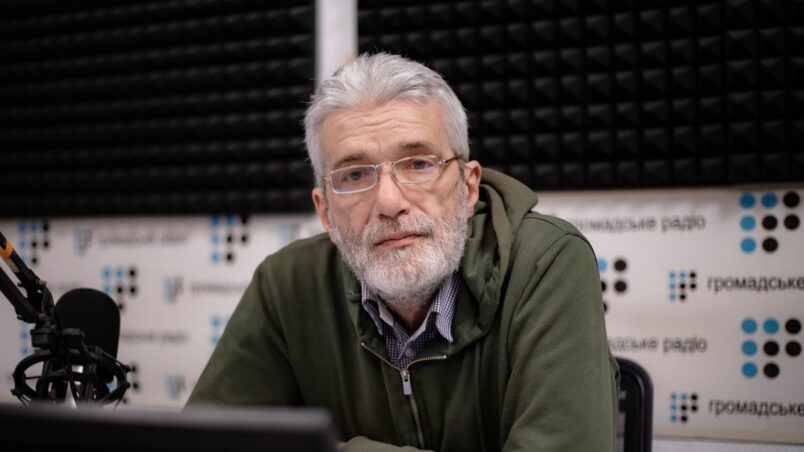
Andriy Kulykov
Head, Commission on Journalism Ethics
Co-founder, Hromadske Radio